I’ve always been an fan of superhero themed games and of course Sean is one of the biggest supers game fans I know, so we were super excited when we learned about a new version of KAPOW! from Wise Wizard Games.
KAPOW! is a dice placement game that uses customizable dice pools and even customizable dice to recreate the escalation of a comic book style battle between heroes and villains.
Disclosure: Thanks to Wise Wizard for hooking us up with review copies of both volumes of KAPOW! Some links in this post are affiliate links, using them doesn’t cost you anything and helps support this blog and our podcast. As an Amazon Affiliate, I earn from qualifying purchases.
Quick Nav Menu, Click to Jump to that section:
- What is KAPOW!? (Game Info & Components)
- How to play KAPOW! (Rules & Gameplay Overview)
- KAPOW! is one of the best comic book battlers (Review & Overall Thoughts)
- KAPOW! vs Marvel Dice Throne, a comparison
What is KAPOW?

KAPOW! was originally published by Two Ton Porcupine but was then picked up by Wise Wizard Games who did some tweaks and re-released the game as a two box set, KAPOW! Vol. 1 and KAPOW Vol. 2. In this review we will be looking at both volumes together.
The original KAPOW! was designed by Larry Bogucki, Douglas Hettrick, and Carl Van Ostrand. This new version had some further design and development from Wise Wizard’s Robert Dougherty.
The first thing you need to know is that both volumes of KAPOW! are nearly identical. Everything from the rules of the game to the actual physical components you are 95% the same. The only difference is that each features a different set of six characters, three heroes and three villains. To go with this, there are a few tokens that are for specific characters that are different in each set as well.
The second thing you need to know about this version of KAPOW! is that to play it with four players, you will need both sets. I will also add, that you probably want both sets, as we found playing with four to be the best way to play.

A single game of KAPOW! can last from thirty minutes to over an hour depending on luck, AP (analysis paralysis), player skill, and player count. Solo games on the other hand only take about fifteen minutes and this game is worth playing solo.
While there are a lot of icons in the game and each character is very asymmetric, the mechanics are rather simple. Learning to play is quick and easy, learning to play well, that’s something else. While the box notes that the game is for age twelve plus, that may be based on component size and not complexity. I can totally see younger kids enjoying this one a lot, and I’m certain nine year old me would have been all over it (that was the year I discovered TSR Marvel Super Heroes).
KAPOW! recreates a super heroic battle between unlicensed heroes and villains who are trying to KO their opponents. This is done through a dice placement, engine building system, that includes customizable dice.
Roll your dice and spend them to attack, defend, and upgrade your character. Play player vs player or combine sets to do a comic book style team up. You can even go Dark Knight and play solo vs any of the characters though a very well done bot system.

Check out the components in this comic based battler in our KAPOW! unboxing video on YouTube. There you can see the customizable dice with their replaceable sides. There are six of these dice in each set and I don’t know how many plastic die sides that you can put onto them.
There are also smaller non-customizable dice in different colours each representing a different speciality. Player screens help hide what you rolled as well as being a great reference for the various icons on the game and what sides are on each of the dice.
Each volume of the game has it’s own unique set of hero and villain side boards and then a main player board for each team. These fold up nicely, though oddly they don’t actually fit all that well behind the screens. There are some counters for specific character powers and a small deck of cards to use when playing in teams.
All of this comes in a rather well designed box insert that holds everything in place pretty well, though I do recommend baggies for some of the components, especially the removable die faces.
Overall the component quality here is really good. There are a couple of things that could be improved, like the size of the player screens vs the player boards, and the fact that I have a couple dice where one side doesn’t want to stick as well as the others, but overall I was impressed.
How to play KAPOW!

The standard way to play KAPOW! is a 1v1, two player game. While the components are set up to play hero vs villain you are welcome to mix and match, heroes can train against other heroes and villains are often at odds with each other.
The rules include an introductory game where you don’t choose characters. I do recommend starting off with that for at least your first game, but for this review I’m going to include the full game.
Each player chooses a character to play and gathers the board and the dice for that character. This will be a mix of non customizable trait dice in different colours and/or customizable action dice with set starting faces. What you grab is indicated on the character boards as is each characters starting health.
Both players place a player screen in front of their player and character boards and roll their dice. They then place these dice onto their boards to activate abilities. There are four types of abilities: attack, defence, power up, and after power up.
Attack and defence abilities are broken into two types, basic moves and kickers. To use a kicker you first have to activate a basic ability, you can’t just use a kicker. Kickers modify the basic movies and you can use any number of kickers on a single basic move.

Power up abilities let you improve your character. This includes gaining new dice, collecting die faces for your customizable dice, or letting you trade die faces for others. After power up abilities are used when you think your opponent will be powering up and do damage for upgrades your opponent takes that turn. Each board also includes a couple of spots that let you re-roll dice and a spot that lets you heal.
Along with the basic actions both players have access to on their main boards every character side board includes additional actions. Most of these cost dice to use, some are better versions of basic actions, others are kickers and there are even some permanent abilities.
Once both players have placed their dice the screens are removed and you resolve all of the actions. The active player attacks first, totalling their damage, then the defending player totals their defence and takes damage equal to the difference if above zero. If this damage is enough to knock out your opponent you win. Assuming they are still standing the defender now collects any defensive upgrades (many of the defensive abilities give you faces for your customizable dice in addition to preventing damage).

Next the initial defender attacks back using the same system. Add up attack, subtract defence, take damage and collect any upgrades. Then, in turn order, players complete their power up and after power up actions.
At the end of each round there’s a clean up phase where players clear all of the dice on their boards and then get to attach and rearrange the faces on their customizable dice. The player with the least health goes first next round with ties going to the villain. The game continues until one player KOs their opponent and wins.
When playing KAPOW! with four players you split into two teams. This would usually be usually two heroes vs two villains but you are free to mix that up. Players on the same team are free to talk, collaborate, and discuss where to place their dice but you can’t trade your dice or play any of your dice onto your partners boards. There is an extra step where players use an arrow token to show which of their two opponents they are attacking.

In addition to each player having their standard actions, each team gets a set of team up cards. These are placed between players on the same team and are activated by each player contributing the appropriate dice to the cards. Players can even flip the cards to swap who contributes what, but again you can’t play your dice on your partner’s side.
If a character is attacked twice in the same round their defence number counts for both attacks but they only collect any upgrades once. Teammates share a health pool equal to the total of each individual character’s health and the last team standing wins.
You can also play KAPOW! solo or cooperatively. Every single character can act as an bot opponent. The back of their character boards show the actions they will take each round. When playing solo, after placing your dice, you roll the opponent’s dice and then work your way down the opponent’s player boards, activating abilities, until they are out of dice.
When playing KAPOW! cooperatively, you play two humans vs two bots, and all attacks are done against the target with the most defence. All other rules stay the same.
KAPOW! is one of the best superhero board games out there.

While the overview of play I just went through covers the flow of the game it doesn’t really give you an idea of the tactical depth in KAPOW! It’s much more clear when you have the boards and dice in front of you. The big thing I’ve found that really makes this game enjoyable is that there’s always something valid to do. There are many ways to spend and combine your dice and even blank die faces are useful.
Many of the actions require a die paired with any other die, some require matching dice and in many cases those dice could both be blanks, others require an action die showing anything but a blank side, etc. There are also two spots on the main player board where you can spend any die to re-roll another one. This makes every roll interesting, and while some rolls may be better than others, it’s hard to call any roll a truly bad roll.
Another thing that may not be clear is the escalation that happens during a game of KAPOW! This is an engine-building game and just like an epic comic book battle, things keep getting bigger as the fight goes on.

At the start of the game you will be forced to stick with basic attacks and defence with maybe a small kicker, while spending quite a bit of dice on improving your character. By the last round you may be pulling off an attack with three kickers and a multiplier as well as reducing the opponent’s defence and doing half of their health in damage in one hit. This escalation really helps to highlight the comic book theme.
My favourite part of playing KAPOW! is the puzzle of figuring out the best use of your dice each turn. There are so many options to choose from and the fact you never have a totally bad roll makes figuring out a cool way to use all of your dice rewarding. This is especially true when you have a roll that looks bad at first but then you find a way to use up all those blanks or extra icons you don’t need.
KAPOW! also has a bit of a bluffing and deduction element. Trying to figure out what you opponent is going to do can be a big part of the game. If you think they are going to upgrade you can make sure to activate your after upgrade abilities. If you expect them to put up a huge defence next turn, maybe it’s time for you to do some upgrading yourself. Do you go all in on a huge attack, or balance between attack and defence? These are all fun and interesting decisions.

Another aspect of KAPOW! that I like is the asymmetry. Each character plays differently and it’s impressive how varied each feel. Different characters lend themselves to different strategies.
This is true on both sides of the screen as well, it’s not only playing them but playing against them that will require you to change up your own play style and figuring out what works best against which character is part of the fun of the game.
Then you get into team games and how different characters pair up with each other. While I have enjoyed all of my two player games of KAPOW!, to me, the game really showed its true strength through team play.
Creating a comic crossover battle is a ton of fun. One of the big advantages playing in teams has is that you get to work with a partner, another brain and set of eyes. There are always a lot of ways to use your dice in KAPOW! and just like in any puzzle, having a teammate there to point out things you may have missed can be very helpful.

I was also impressed by KAPOW! as a solo experience. I think it works well as a single player game because of that puzzle aspect. The entire bot system isn’t too fiddly and I like the way you have to spend all of your dice before rolling for the opponent so you don’t know if they are going to attack, defend, etc. I appreciate that every single character, hero and villain, has it’s own solo version. That gives you a lot of possible combinations to try out, especially if you own both sets.
Our biggest concern with KAPOW! are the customizable action dice. Right from the start I found that at least two of my dice had at least one side where the faces didn’t hold on as well. Currently, whenever I notice one of these “lose” dice I just swap it for another one, only using those dice if I have to. Then if I do end up having to use them I just make sure to fill the problematic side last.
My big worry is that this will get worse over time. So far that hasn’t happened, the lose dice started that way and have stayed that way. Wise Wizard Games has stated that they have many demo copies of both volumes of KAPOW! that have been played far more times than an average gamer would play a copy and their dice have all been fine. So it seems like this is not a common problem, but one that may come up.

Overall I’ve enjoyed KAPOW! since a short demo at a convention followed by my first play with my daughter, at one of our public play game nights. Every game I’ve played since has been close, you never know who’s going to win up until the very end.
I love how different each character feels and plays and the different strategies that come out from each as well as the fact that the characters seem very well balanced against each other. I would have been happy with this game as a two player only dueling game but found I enjoyed it even more at four players and also enjoyed playing solo.
If you like super hero games, KAPOW! is definitely worth looking at. It feels tight and thematic. While it may not feature licenced characters, the characters they have created fit most of the standard tropes and are pretty cool. What will really draw you in though is the escalation that occurs as you play. This really helps emulate the feel of an epic comic book battle.
If you dig dice games and love trying to figure out the best way to use a bad roll, you are probably going to love KAPOW! The same goes for puzzle game fans who like trying to find the ultimate combo or to squeeze one more point of defence or attack out of your limited resources.

On the other side of things, if you don’t like conflict in your games you are probably best staying away from KAPOW!, though you still may be interested in the solo or cooperative game play modes.
The same thing goes for players who hate the randomness of dice. This game involves a lot of dice rolling. That said, as I mentioned earlier, there’s never a point in KAPOW! where you can’t do something with your dice. Even rolls that seem bad can turn out quite good.
KAPOW! vs. Marvel Dice Throne

Before I wrap things up here I want to spend a moment comparing KAPOW! to another dice driven, superhero battle game that I reviewed in the past: Marvel Dice Throne from The Op. I think it’s very hard, if you’ve played both of these games, to not compare them, and I encourage anyone who hasn’t played Dice Throne yet to check out our Marvel Dice Throne Review.
I enjoy both games and appreciate how each game does its own thing, each feels different. This is despite the fact that both of the games focus on super hero battles resolved using dice to activate powers on boards. They both even include a team up mode when playing with more then two players.
Each of these dice games are well balanced while having a high level of asymmetry which you all know is something I love. They are also both expandable by adding additional sets, though at this point KAPOW! just has the two volumes where as new Dice Throne content is still being released.

What I do think Marvel does better is to nail the theme, but that’s just because if features Marvel characters. This theming comes from the decks and abilities for each character, which makes playing each of them feel like you are controlling the matching Marvel character. Loki is filled with randomness and tricks and illusions, Thor has need to build up power before releasing big attacks and can of course throw and retrieve his hammer.
While each character in KAPOW! plays differently, I don’t know enough about these characters to know if they feel right.
Other that, I prefer KAPOW! I love asymmetry, I love engine building, and while there are upgrade cards in Marvel, you don’t really get the feeling of escalation that you do with KAPOW! I also really love the puzzle aspect of KAPOW!, and getting that seemingly bad roll and making it work is such a great feeling. A bad roll in Dice Throne is just a bad roll. Dice Throne also does not have a way to play solo.

There is one final factor here, which is ease of play. Marvel Dice Throne is a much more approachable, easy to learn, game that plays much quicker than KAPOW! It’s also quicker to set up and take down thanks to the fantastic character trays. Because of this, Marvel is a better game for kids and families, and is going to be a good choice for a more casual game night. It’s a great beer and pretzels game where you can chat and socialize while playing.
It’s not that KAPOW! is what I would call heavy, but when compared to Dice Throne it does require more thinking and focus. Due to that, which game is best for your group is going to depend on what kind of game you are looking to play.
Marvel Dice Throne and KAPOW! are only two of many super hero themed board games out there. What’s your favourite? I wonder if we’ve played it yet?
Leave a comment below and let us know about your favourite comic book inspired board games.
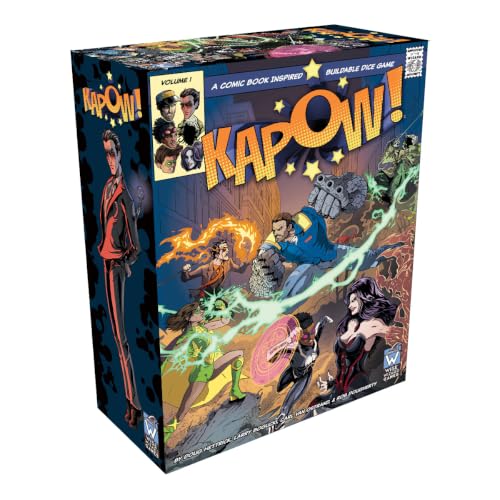
- Players go head-to-head in a classic explosive class of good vs. evil by choosing to be a villain or hero
- Gain additional blank ‘’action dice’’ that have removable faces that you can customize to your liking to best enhance character
- Behind a player screen, you roll a dice; allocate them to attack, defense, and power up abilities