Pirate Tails is a simple to learn, but engaging game where pirate squirrels are competing to collect the best horde of nuts. The problem is they don’t have the best memory.
This game is light enough that kids will enjoy it but also has enough depth to keep gamers entertained. This makes Pirate Tails perfect for a family game night or casual game night with your friends.
Disclosure: Thanks to Skybound Tabletop for shipping this one over to us. We didn’t know it was coming and it was a pleasant surprise. Some links in this post are affiliate links. Using these links doesn’t cost you anything extra and it helps support this blog and podcast. As an Amazon Affiliate, I earn from qualifying purchases.
Quick Nav Menu, Click to Jump to that section:
- What is Pirate Tails about? (Theme & Components Overview)
- Playing Pirate Tails (Rules & Gameplay Overview)
- Pirate Tails was a pleasant surprise (Review & Overall Thoughts)
Pirate Tails is a light set collection game with strong memory elements

Pirate Tails comes from Skybound Tabletop. It was designed by Whitney Loraine and features artwork by Sonya Hena. It was published last year and should be available at your FLGS as well as most online stores and some mass market locations.
This memory based game plays two to five players with games going nice and quick, clocking in at under thirty minutes even at the highest player counts. Due to the nature of the game, and it’s quick playtime, we’ve found most groups want to play a few games in a row.
Board Game Geek lists Pirate Tails as having a weight of only one. Don’t let this fool you, while the basic mechanics are pretty simple, there is strategy. Tactics, memory, and card counting are required to play well.
The suggested age of eight or older seems about right to us.
In Pirate Tails you are a scurvy squirrel trying to amass a horde of nuts. Each turn you will draw three nut cards from the deck, one you will keep, one you will place on an island (face up) and one you will bury at a different island (face down). Instead of drawing new cards, you can take all of the cards at any one island. A round ends when all cards from all islands are claimed. Points are awarded for sets of nuts (and candy) at the end of three rounds.
The component quality in Pirate Tails is what you would expect from a mass market card game. The entire game consists of one deck of cards. There are no tokens or anything like that. The box has a cardboard insert that you will have to remove if you want to play with sleeved cards. You are probably going to want a pencil and paper or a scorekeeping app, especially if you plan on playing for more than one round.
While I didn’t love the art in this game, it is very clear and colour blind friendly due to the unique nut artwork for each “suit”. The artwork is large and the numbers are clear and easy to see from across the table.
How to play Pirate Tails

Start a game of Pirate Tails by placing out a set of hiding places equal to the number of players. For each player select two different suits of nuts and include two candy cards. Shuffle all of those together and you are ready to start.
Each turn players have two options, Raid a Hiding Spot or Search for Nuts. The most common action will be to search for nuts and at the start of the game it’s the only option.
When you search for nuts, you draw three cards total, one at a time. After drawing each card you have to decide what to do with it before you draw the next. You have three options for what to do with your drawn cards.
You can keep the card by placing it face down in front of you, into your personal stash. Only you can look at your stash and you will score all the nuts in your stash as the end of the game.
You can reveal the card you drew by playing it face up at one of the hiding places. Each hiding place can only hold five cards.
Your last option is to bury those nuts. You do this by placing the card face down at a hiding place. Again you are limited to five cards per spot.

Each of these three options can only be taken once per turn and the card you place face up can’t be at the same spot as the one you bury (unless that is the only valid place left to play it).
Instead of searching for nuts, you can go raiding. You do this by taking all of the cards from one hiding place. Some of these may be face up and some may be face down, so you may not know what you are getting. If all of the hiding spots are full at the start of your turn you must Raid, and if all of other players have already raided the final player must Raid, even if there is room left at the final locations.
Cards collected go into your personal stash and can be looked at but must remain in the same state they were taken in. Face up cards stay face up and face down cards stay face down.
The round ends when all of the hiding spots have been raided. A new round begins with the player who raided the last spot. Players keep all of the cards they have collected between rounds. The game continues for three rounds, reshuffling the draw deck as needed.
At the end of the third round everyone calculates their scores. Each set of nuts of the same type is worth points based on how many you’ve collected. You get no points if you only collect one nut of a type. If you have two nuts of the same type you score the lowest value one. With three nuts of the same type it’s the middle number that scores and if you manage to get four or more nuts of the same type it’s the highest numbered one that gives you points.

Mixed in with the nuts are candy cards. Squirrels love candy, but eating too much makes them sick. You get five points each for the first two candy cards you collect. If you collect three or more candy you ate too much and get no points for those cards (but still score your nut collection as normal).
That’s all there is to Pirate Tails, it’s that simple. Each round you collect cards or draw three cards and decide what to do with them. After three rounds everyone totals their points.
Pirate Tails‘ simple mechanics hide surprising depth.

Reading through that how to play section gives you a great idea of how Pirate Tails plays but what it doesn’t really get across is how much strategy and memory is required to play the game well.
One small hurdle to entry is the unique scoring system. When teaching the game there’s always a player or two that doesn’t really get it until we add up the points at the end of the game.
You get nothing for one nut, score your lowest for two, the middle for three and the max for four. This sounds simple enough but people tend to not quite get what it means until they see it.
For example, if you have a twelve (the highest card) in a suit but it’s paired with a zero, you get no points, which is also what you would score if you had that twelve on it’s own. However, if you also had a three, you now have three cards in that suit and so score that three. The only way you will ever score a twelve is to have four or more matching nuts in that suit.
I’ve played more than one game where a player tries far too hard to collect every single card of one nut type only to be disappointed when they only get to score one of them. There’s really no reason to collect more than four of a suit unless you know you are getting a higher card. Of course that doesn’t take into account taking cards simply to deny other players.

For your first game I suggest playing just one single round of Pirate Tails. Once you’ve scored that round and made sure everyone is on the same page, you can restart and play a full game.
Besides scoring, another thing that adds depth to Pirate Tails is the card distribution. In each suit of nuts you get only one zero, then two each of cards numbered one, two, three and five, and then a single eight and a single twelve. Plus there’s the candy. Each game there will be two pieces of candy in the deck per player.
Now I’m not saying this is a card counters dream or anything. It’s still pretty light, but you do have to pay attention to what’s going on, both with what you are collecting and with what the other players are doing.
The weight of the game also depends a lot on the player count. The more players the lighter it gets as there’s no way to keep track of everything. The more players you add, the more reactionary the game becomes. There are far too many face down cards and too many variables at play to really count cards and plan out a long term strategy.
I think Pirate Tails is the perfect weight for a get to know you game, something to kick off a game night or something to fill in the gap between games. We’ve found it’s great for public play as the game not only looks super approachable, it actually is.
Skybound is really impressing me with their lighter card games. Before checking out Pirate Tails we reviewed Kiss the Goblin, which also ended up being way more fun than we expected. The thing is Pirate Tails isn’t just more fun than we expected it’s also deeper and more engaging.

If you are looking for a light, accessible, card game that’s good for a casual gathering of gamers or a family game night, Pirate Tails is a good choice. It’s a very welcoming game that isn’t too simple.
I have found that this game also has some similarities to Biblios and its follow up For The King and Me, which tend to attract more seasoned gamers. If you do generally prefer heavier card games don’t overlook Pirate Tails, there’s some real thinking required here and the game does reward long term strategic play.
That brings us to the end of our Pirate Tails review. Now I think it’s time for a snack of mixed unsalted nuts. While we’re munching down on those, why don’t you let us know what your favourite pirate themed board game is? We’ll check the comments when we get back from our snack!
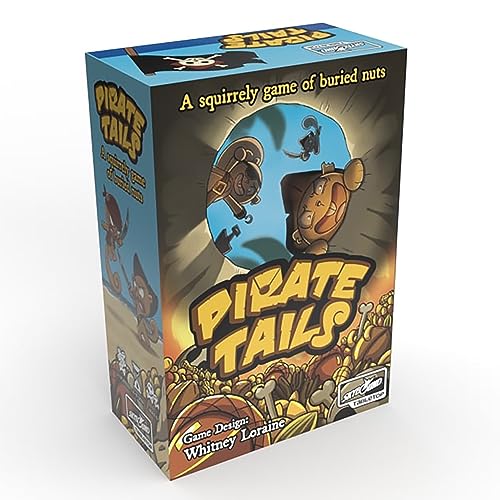
- PIRATE TAILS is a set collection game.
- FUN THEME: Play as a squirrel working to gather the best nuts!
- SORT YOUR NUTS: In each round, draw nut cards and choose which ones to score, reveal or hide.