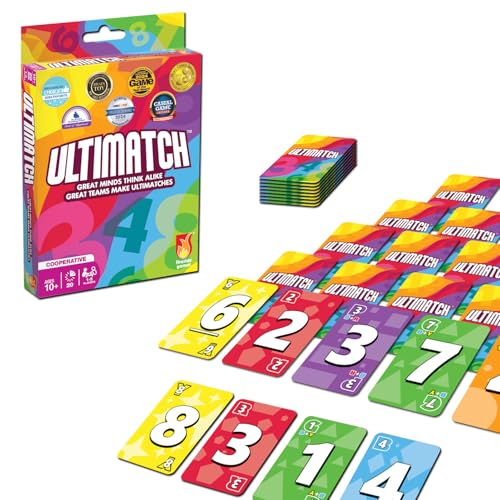
Ultimatch is a hot new cooperative game from Fireside Games (of Castle Panic fame) that took GAMA Expo by storm. By the end of the convention it seemed like everyone was talking about this card game.
In Ultimatch players work together to try to clear a pyramid of cards in what feels a bit like a multi-player version of Pyramid Solitaire. There’s more depth here than you may think, with players matching colours or numbers, including using, addition, subtraction, and colour combos.
Disclosure: Thanks to Fireside Games for giving us a pre-release copy of Ultimatch. Some links in this post are affiliate links. Using these links doesn’t cost you anything extra and it helps support this blog and podcast. As an Amazon Affiliate, I earn from qualifying purchases.
Quick Nav Menu, Click to Jump to that section:
- What is Ultimatch? (Theme & Components Overview)
- Playing Ultimatch? (Rules & Gameplay Overview)
- Who should pick up Ultimatch? (Review & Overall Thoughts)
What is Ultimatch the card game?

Ultimatch was designed by Anne-Marie and Justin De-Wit and is published by Fireside Games. The game started showing up on store shelves back in June.
Ultimatch is a one to five player cooperative card game with a lot of similarities to Pyramid Solitaire. It plays in about twenty minutes and will work with gamers of almost any age, as long as they know their basic colours and can add and subtract.
One of the best things about this cooperative card game is it’s price point, with an MSRP of only $9.95 USD.
The goal in Ultimatch is for players to work together to clear a pyramid of cards using both the cards in their hand and from a shared tableau. Players will match colours or numbers with a single card, or a pair that sums to the right total or creates the right colour when mixed. Winning will require you to trade with other players, strategically pass, and increase your options by forming an Ultimatch! (a.k.a.) a pair of cards that matches both the number and colour of a card in the pyramid).
Physically, there’s really not a lot to Ultimatch. It’s a single deck of very clear and colourful cards. They come in six colours, the primary and secondary colours, and each colour has a set of cards numbered one to eight.

The game comes in a small box and with a clear set of instructions. You even get some reference cards which are great for your first couple of plays and also serve as a good reminder for when you pick the game up after it sits on your shelf for a bit.
Our only complaint regarding component quality here is the box. The box is larger than it needs to be, and aside from that whole companies shipping empty air thing, it doesn’t even work to hold the game very well once you’ve opened everything up.
The box is a large flat rectangle with a floppy cardboard insert inside it that is sized to the deck. It’s not only not quite tall enough to hold the entire deck, the way it’s constructed cards end up sliding under parts of it.
Playing Ultimatch

You start a game of Ultimatch by building a card pyramid. The pyramid will have five rows when you are playing with three or less players and six rows when you are playing with more. Either way, only the bottom row of cards is face up.
You will also need to deal each player a starting hand of cards. From this hand each player contributes one card face down to the alta-hand. This is a tableau of cards in the center of the play area that everyone can use throughout the game. Once everyone contributes a card, you flip them and the player who contributed the highest card gets the first play.
Each turn in Ultimatch starts with the option to swap a card with another players. Players can suggest trading or you can ask for help. When trading both players pass a single card face down to the other player.
Next, the active player must play a match if they can. If they cannot make a match they must pass and draw a card. The game ends, and all players lose, if every player passes, all in a row. If even one player can play a card, this resets and the game continues.
To make a match, you can play a single card that matches the colour or number of a face up card in the pyramid. Both cards are discarded and newly uncovered cards in the pyramid are revealed. If the final card in the pyramid is matched the players win!
Instead of playing a single card, you can also play a pair of cards. When playing a pair you can use addition or subtraction to make a number match or mix colours to make a match. For example you could play a red and a blue card to match a purple card in the pyramid. In either case all three cards are discarded, and any newly uncovered cards in the pyramid are revealed.

If you can play two cards that together match both the colour and the number of a card in the pyramid, then you have just made an Ultimatch!
Using the example I just mentioned, if you have a red card that is a two and a blue card that is a three that would be an Ultimatch! with a purple five in the pyramid. Whenever you get an Ultimatch! you get to draw two cards. You place one of these cards in your hand and the other one gets added to the alta-hand.

When playing a card or pair of cards they can come from your hand, from the alta-hand, or from a combination of both. If your only valid play must use cards from the alta-hand, and only the alta-hand, you may pass.
To keep things interesting there are limited communication rules in play during a game of Ultimatch. While players are free to discuss when and how to use the cards in the alta-hand they cannot discuss, in any way, or show other players, the cards in their hands.
If your group finds the game to be too easy, there are two ways you can up the difficulty. The first is that a random alti-hand card is removed at the start of the game and the second is that both cards from an UItimatch go into the players hand instead of one getting added to the alta-hand.
If you are finding Ultimatch too difficult you can add a random card or two to the alta-hand at the start of the game or allow players two trades per turn.
Who should check out Ultimatch?

Deanna and I got to try Ultimatch at GAMA Expo, which we attended as hosted media.
We played during the wrap up open game night when our friends from the Everyday Board Games podcast invited us to play with them. Danny McKinley, the designer of Matches, really wanted to play with us because they had tried the game the night before and lost, but were really close. They were certain we could win it together, and they were right!
Even before we sat down Deanna was already keen to try the game as it reminded her of playing Pyramid Solitaire as a kid, especially some variant cooperative version she used to play with her mother.
It’s not often Deanna enjoys a cooperative game, so when she suggested we ask for a review copy after that game with our Everyday Board Game friends, I wasn’t going to say no. Plus, the quick teach, high player interaction, intensity, and energy levels we saw from everyone playing at that event made me think it would be a perfect fit our local public play events. So thanks again to Fireside for shipping us a copy after GAMA Expo.

Once the game showed up, Deanna was excited to play it with her mom so we broke it out that weekend, which happened to be Mother’s Day. It started off as a big hit. Both Brenda and the kids were enjoying it, at first. The problem was that we just kept winning.
Our biggest concern with Ultimatch is that it’s too easy. Now that comes from a group of people who have played a lot of cooperative games together, so maybe that’s the issue. At this point we’ve gone more than ten games in a row without a single loss.
After the first five wins we tried upping the difficulty level as suggested in the rules. While this did make the games more enjoyable and tighter, we still haven’t lost a game. My daughter also brought the game with her to school and the kids in her high-school had a similar experience. They had fun, but then found they were winning every game.
For a cooperative game to have staying power and continue to be enjoyable I want to lose at least 40-60% of the time, maybe even more. When you do win you want it to be tense and close and you want to just make it. When you lose, you want almost make it, which makes you want to try again.

The best cooperative games I’ve played you end up playing over and over until you win, often in a single game night. They have a “okay let’s try one more time, I’m sure we will get it this time” feel that we found lacking in Ultimatch.
Now, this is a mass market card game that is being sold next to games like UNO and Skip-Bo so maybe the difficulty level is intentional. I do think that casual players who aren’t used to cooperative hobby board games may find the game to be much more difficult
However, as one of those cooperative hobby board game fans, I want the odds to be against me more, and I think most of you reading this review will probably feel the same.
Personally, I think UIltimatch is okay. I would play it again if someone asked me to play and I do often bring it out to public play events where I expect there will be casual gamers. The first few rounds of this game seem to be a hit with both hobby and casual gamers, and people do seem to enjoy winning on their first play.
My oldest daughter enjoys Ultimatch and my mother in law likes it quite a bit. She noted that it was nice to have a game where you can win often. Deanna on the other hand, who is the one that wanted to get this game in the first place, isn’t really interested in playing again.

If you are a mass-market, small box card game fan, who likes games like UNO, Phase 10, and Skip Bo, you will probably dig Ultimatch. The cooperative nature of this game will be something new and interesting for fans of those classics.
Do you have kids that are into card games? I think Ultimatch is a great game for kids. The entire family can play together and it’s good at reinforcing basic math skills and colour addition.
If you are looking for a quick playing cooperative game you could fit in during a work break, lunch, or as a starter while waiting for players to show up, Ultimatch could be a great choice, but, if you are looking for a difficult cooperative game that is unforgiving and requires everyone to really work together, you may be a bit disappointed in Ultimatch.
That’s it for our ulti-review of Ultimatch. I hope this helped you make a decision on whether or not this cooperative card game is right for you and your group.
I still think at under $10 this game is worth giving a shot to see if it’s right for you and your group and almost a no-brainer if you’ve got kids who are already into games like UNO.
What I’m most curious to know is if people enjoy easy games? Do you enjoy playing co-op games with a high win ratio? Do you like games that are easy to win? Tell us about it in the comments below!